Why the “A Stronger Workforce for America Act of 2026” Falls Short—and Why Your Voice Matters Now

The House Education and Workforce Committee is preparing to take up the A Stronger Workforce for America Act of 2026 (ASWA 2026) as soon as next week. As drafted, this bill represents a significant step backward for the nation’s workforce development system at a time when workers, job seekers, and employers urgently need more support, not less.
At NAWB, we believe deeply in the power of locally driven workforce solutions. Workforce boards across the country are helping people adapt to rapid technological change, navigate economic disruption, and are helping local employers find skilled workers. But ASWA 2026, in its current form, undermines that mission in several critical ways.
ASWA 2026 Fails to Invest in the Workforce System
Federal funding for workforce development has steadily declined for two decades. Congress has never funded the Workforce Innovation and Opportunity Act (WIOA) at its authorized levels.
Yet instead of reversing this trend, ASWA would:
• Freeze funding levels for Adult and Youth programs for six years
• Cut Dislocated Worker funding by nearly 5%
This comes at a time when AI, automation, and advanced technologies—which Congress and the administration are supporting and investing in—are reshaping the labor market. Workers and employers need more support to stay competitive. This bill does not meet that moment.
A Rigid 50% Training Requirement Doesn’t Reflect Local Needs
Local workforce boards understand their communities. They know which industries are growing, which skills are in demand, and what barriers job seekers face.
ASWA 2026 would implement a one‑size‑fits‑all 50% training expenditure requirement for Adult and Dislocated Worker programs. While the bill allows a 10% set‑aside for supportive services or individualized career services, this new mandate is arbitrary and disconnected from real‑world needs.
This requirement would:
• Force boards to meet a metric rather than serve people holistically
• Limit funding for essential services like business engagement, labor market analysis, and sector partnerships
• Ignore barriers—such as childcare, transportation, or housing—that often determine whether someone can complete training at all
If training is needed, shouldn’t we prioritize the successful completion of that training? This often requires these wraparound services, including case management, to ensure the appropriate supports are in place.
Expanded Governor’s Reserve That Reduces Local Capacity
ASWA 2026 would allow governors to set aside an additional 10% of state allocations (on top of the existing 15%) for a new Critical Industry Skills Fund.
While supporting critical industries is important, this approach would further divert vital WIOA funding away from serving workers and employers. The U.S. Department of Labor has already distributed grants for this purpose. Duplicating that effort at the expense of local funding is misguided.
Single State Redesignation Authority Undermines Local Leadership
Under ASWA 2026, states with fewer than 5.1 million people (or fewer than six local workforce boards) could redesignate as Single State Areas. At least 26 states would qualify.
This would be a dramatic departure from WIOA’s design, which centers local business and civic leadership in workforce decision‑making. Consolidating authority at the state level risks weakening the responsiveness and innovation that local boards bring to their communities.
A Block Grant Pilot Threatens the Local Workforce Model
The bill would also expand the Make America Skilled Again (MASA) block grant concept from the Administration’s FY2027 budget request.
The pilot would:
• Allow up to 10 states to collapse multiple workforce funding streams into a single block grant
• Remove previous guardrails related to labor market participation and population
This shift would jeopardize the success of the locally driven workforce system and concentrate funding authority at the state level, moving away from the community‑based approach that has proven effective.
So, where do we go from here?
NAWB has been deeply engaged with lawmakers, committee staff, and partners across the workforce ecosystem to ensure that any reauthorization of WIOA strengthens—not weakens—the system that millions of workers and businesses rely on.
We have:
• Provided detailed feedback on ASWA provisions
• Shared data and stories from local boards nationwide
• Coordinated with national partners to amplify concerns
• Engaged directly with committee members and staff
• Advocated for increased funding and flexibility to meet local needs
We will continue this work, but your voice is essential.
Take Action: Contact House Education and Workforce Committee Members Today
The committee may take up ASWA 2026 as soon as next week. Now is the time to make sure lawmakers understand how this bill would affect your community.
Contact your lawmakers on the House Education and Workforce Committee [link to https://edworkforce.house.gov/committee/fullcommittee.htm] and share your concerns about ASWA 2026.
[Link to Committee Contact Page]
Tell them:
• Local workforce boards need flexibility—not rigid mandates
• Funding must reflect the scale of economic trends, new work requirements, and technological change
• Workforce development works best when decisions are made close to the community
• ASWA 2026, as drafted, does not meet the needs of workers, job seekers, or businesses
Your outreach can make a real difference in shaping the future of workforce development.
Contact us at NAWB (link to nawb@nawb.org) for assistance. We are here to help.

Trump Administration Releases Initial FY27 Budget Request

Topline Overview

The Trump Administration released its initial Fiscal Year 2027 (FY27) budget request on April 3rd, proposing significant shifts in federal spending priorities. The budget includes $1.5 trillion for national defense—a 44 percent increase over the FY26 enacted level—while cutting non-defense discretionary spending by 10 percent compared to current funding. For workforce development stakeholders, the U.S. Department of Labor (DOL) would see its discretionary budget reduced by $3.5 billion, or nearly 26 percent, from FY26 if enacted.

The release represents the Administration’s top-level “skinny” budget. Additional details, including Congressional Budget Justifications, are expected in the coming weeks and will provide greater specificity on program-level funding for workforce development and related investments. NAWB will continue to analyze these materials as they become available.

U.S. Department of Labor

The budget requests $9.9 billion in discretionary funding for DOL in FY 2027, down from $13.3 billion in FY 2026. The Administration frames this reduction as a streamlining of the federal workforce system, with DOL positioned as the lead agency for several programs proposed for transfer from other agencies—including Career and Technical Education programs currently housed at the U.S. Department of Education (ED).

The central workforce proposal remains the “Make America Skilled Again” (MASA) grant, which would consolidate multiple WIOA Title I formula and competitive programs into a single block grant to states and localities. The budget does not specify a funding level for MASA in this version of the request but describes it as key to expanding Registered Apprenticeship Programs (RAPs) to help meet the Administration’s goal of one million active apprentices. A related factsheet indicates that 10 percent of MASA funds would be reserved for RAPs. The budget also cites Workforce Pell, enacted last year, as a complementary tool for workforce training.

The budget proposes the following specific cuts and eliminations at DOL:

  • Job Corps — eliminated (–$1.6 billion): The budget again proposes fully eliminating Job Corps, following the Administration’s 2025 closure attempt that was blocked by a federal court injunction. The justification cites high per‑graduate costs and poor employment outcomes.
  • Senior Community Service Employment Program (SCSEP) — eliminated (–$395 million): The budget proposes eliminating SCSEP, which provides subsidized employment and training for low‑income adults aged 55+, citing duplication with other federal programs, including MASA.
  • Office of Career, Technical, and Adult Education (OCTAE) (–$1.5 billion): The Budget prioritizes the partnership between ED and DOL and transfers career and technical education to DOL while also eliminating Adult Education.

Next Steps

It is important to note that this budget request is a proposal—Congress must still act on annual appropriations bill and lawmakers are unlikely to adopt these cuts in full. When faced with similar proposals in the FY26 appropriations process, Congress rejected the administration’s workforce consolidation plan and maintained separate WIOA program funding.

NAWB will continue to monitor developments as additional budget details are released and appropriations work begins and will continue to advocate for strengthened investment in workforce development initiatives.

Your advocacy is important, too. Contact your members of Congress and let them know how such drastic cuts to the Department of Labor could jeopardize the work you do.

National Association of Workforce Boards and Microsoft Elevate Partner to Build AI Skills Across the American Workforce

FOR IMMEDIATE RELEASE

March 26, 2026

National Association of Workforce Boards and Microsoft Elevate Partner to Build AI Skills Across the American Workforce

New collaboration delivers free, LinkedIn Learning-based AI courses aligned to the U.S. Department of Labor’s AI Literacy Framework

WASHINGTON, D.C. — The National Association of Workforce Boards (NAWB) today announced a partnership with Microsoft Elevate to equip job seekers, career coaches, and workforce agency professionals with the artificial intelligence skills needed to succeed in today’s rapidly changing labor market. The initiative brings free, practical AI training to workforce development organizations nationwide.

Through this collaboration, NAWB and Microsoft Elevate have developed a suite of LinkedIn Learning courses grounded in real-world scenarios created with workforce professionals. The curriculum is shaped directly by the needs of workforce agencies and aligned to the U.S. Department of Labor’s AI Literacy Framework, ensuring learners build skills that are both practical and nationally recognized.

“Workforce boards across the country are on the frontlines of preparing Americans for the jobs of tomorrow. This partnership with Microsoft Elevate gives our members the tools and training they need to help workers adopt AI responsibly and confidently — and positions the workforce system as a leader in AI readiness.” — Andrew Bercich, CEO, National Association of Workforce Boards

“At Microsoft Elevate, we believe in the power and potential of individuals first. That’s why our partnership with NAWB is focused on meeting job seekers, coaches, and workforce professionals right where they are. By empowering people across the workforce with AI literacy and skills aligned to their roles, we can help people not just adapt but truly flourish in the AI era.” — Justin Spelhaug, Vice President, Microsoft Elevate

The partnership offers three dedicated AI courses available at no cost through LinkedIn Learning:

  • Generative AI for Career Growth and Job Search — Designed to help job seekers leverage AI tools in their employment journey. aka.ms/AIforJobseekers
  • Generative AI for Career Coaches — Equips career coaches with AI skills to better serve clients. aka.ms/AIforCareerCoaches
  • Generative AI for Workforce Agency Administrators — Helps agency staff integrate AI into their operations and service delivery. aka.ms/AIforWorkforceAdmin

Participants who complete a course will earn a certificate through LinkedIn Learning. For more information about the program, visit aka.ms/AIforWorkforce.

About NAWB The National Association of Workforce Boards (NAWB) represents approximately 550 workforce development boards and their partners across the United States. NAWB advocates for policies and investments in workforce development that help individuals connect to meaningful employment and help businesses find the skilled workers they need to grow.

About Microsoft Microsoft (Nasdaq “MSFT” @microsoft) creates platforms and tools powered by AI to deliver innovative solutions that meet the evolving needs of our customers. The technology company is committed to making AI available broadly and doing so responsibly, with a mission to empower every person and every organization on the planet to achieve more.

Media Contacts

Microsoft Media Relations We. Communications (425) 638-7777 rapidresponse@wecommunications.com

Grace Moster Novel Strategies gmoster@noveldc.com


Message from the CEO — Six Weeks Until Forum 2026

This week marks six weeks until the start of Forum 2026 in fabulous Las Vegas, Nevada.

As we get closer, I wanted to take a moment to share some of the exciting things we have in store for you before, during, and after the Forum—and how this year’s experience has been intentionally designed to help you grow as a workforce development leader.

Before getting into specifics, I want to share an important shift we’ve made this year: we’ve redesigned the Forum to be more impactful. That means fewer sessions than in past years—but each session will be longer (75 minutes), highly interactive, and focused on giving you practical tools you can take home and implement in your local area.

It’s not enough to simply hear about good ideas happening across our industry. We need to turn those ideas into action. That’s exactly what this year’s Forum is designed to do.

We also know that pre-conference sessions aren’t always the right fit for everyone. So, this year, in addition to our pre-cons, we’re excited to introduce post-conference sessions—giving you the opportunity to continue learning even after the main conference wraps up.

Lastly, before I share some of the specific things we are doing to make this Forum memorable and the best ever, I want to recognize that this is a change from what we have always known at the Forum.  I know there is value in being in DC, but this evolution of the Forum allows us to unlock new possibilities that will make this year’s experience our most impactful yet.

DC in the Desert

Many of you attend the Forum to stay connected to federal policy and strengthen your advocacy efforts. This year, we’re bringing DC to the desert.

We’re thrilled to welcome Deputy Secretary Keith Sonderling (U.S. Department of Labor) and Deputy Assistant Secretary Nick Moore (U.S. Department of Education) as main stage participants. We’re also grateful to have The Honorable Dina Titus U.S. Congresswoman (NV-1) joining us for our Executive Director and Board Chairs meeting.  And we aren’t stopping there; we hope to have additional announcements over the next few days.

We’re also investing heavily in advocacy this year through a dedicated Advocacy Track, including training on how to effectively advocate at the national level—highlighted by a session led by former Congressman Jon Porter on making meaningful impact with federal elected officials – and sessions focused on state, county, and municipal advocacy. We’re seeing some of the most successful boards in the country capture momentum by leveraging influence at every level of government—and we want to help you do the same.

Forum Awards

One of my favorite parts of the NAWB Forum is the opportunity not just to gather, but to celebrate the best and most innovative work happening across our workforce system. The Forum allows us to elevate the strategies, partnerships, and leadership that are driving real results in communities across the country.

This year, we’ll highlight forward-thinking practices and the outstanding partnerships at the heart of WIOA. If your board is doing work you’re proud of, I encourage you to nominate your board for a Forum Award. Sharing your story helps amplify your impact—and gives others across the system real examples they can learn from and build on. The deadline to submit your application is February 19th.

Pre-Cons and Post-Cons

This year you can choose one of these pre-conference sessions on Monday, March 23rd to start your Forum experience:

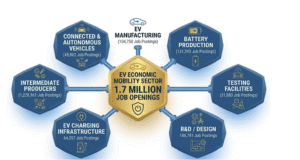
  • We’re also excited to partner with the American Association of Community Colleges (AACC) on a special DOL-funded pre-con workshop focused on the electric vehicle industry cluster and the workforce systems needed to support everything from critical mineral extraction and the lithium battery lifecycle to vehicle manufacturing, retail, and maintenance. Board representatives selected for this session may receive up to $700 in travel reimbursement and will be eligible for up to $10,000 in planning grants through a Shark Tank–style pitch competition. Applications for the EV workshop close this Friday February 13! APPLY HERE.


On Thursday afternoon, March 26th, we’ll launch three post-conference sessions:

  • Working Smarter with AI: Building an Ethical, AI-Literate Workforce with AI expert, Past-Chair of the Colorado Workforce Development Council, Chair of the NGA AI and Quantum Workforce Sector Partnership Subcommittee and author of Thought Partner—The Fusion of Soul and System: The AI Collaboration, Jonathan Liebert. This session moves beyond hype and fear to focus on what truly matters: ethical and responsible AI use, real-world productivity gains, and building true AI literacy across teams. 
  • Level up your grants strategy with Grant Writing: Go, Write Win! led by TAD Grants, designed to help you submit stronger, more competitive proposals with confidence. The session goes beyond theory, breaking down evaluation criteria, proposal scoring, common pitfalls, and real-world strategies for client management, contract negotiation, and organizational readiness—so you can submit high-quality applications on time, every time. Normally $995, this special session is available for $595 for NAWB Members and $695 for Non-Members—an exceptional value for a comprehensive, hands-on grants training.  *Please note this session runs through the end of the day on Friday, so please plan your travel accordingly. (Forum room rates are still available Thursday and Friday nights.)

Partner Track Excursions

We’ve been excited to see how many attendees are bringing travel companions this year—about one in eight registrants so far. Because of that, we’ve built out a slate of excursions and experiences that we are calling our “Partner Track” to make the week memorable for everyone.  These are excursions designed for your travel companions, but I totally understand if you want to sneak away to see the Hoover Dam on Friday.

Excursions include:

  • Tuesday (3/24): Allegiant Stadium tour – home of the NFL’s Las Vegas Raiders and the UNLV Runnin’ Rebels
  • Wednesday (3/25): Area15, Imersive experiential museum, including Meow Wolf – Omega Mart, Illuminarium, and more

Now Is the Time to Book

If you haven’t finalized your plans yet, now is the perfect time to do so. We ask you to book your room at The Cosmopolitan, the official hotel of The Forum 2026, to stay connected to the full Forum experience and take advantage of our discounted room block.

And for a limited time, you can also save 10% on standard Forum registration during our President’s Day sale by using the code FRMVEGAS26. Tickets at this rate won’t last long.

I can’t wait to welcome you to Las Vegas and to Forum 2026. It’s shaping up to be one of our most impactful gatherings yet.

See you in Vegas!

Drew

Celebrating Bob Knight: Founder, Builder, and Lion of the Workforce Ecosystem

There are leaders who serve a system—and then there are leaders who build one.

As Bob Knight enters retirement, NAWB honors a career that helped shape the workforce ecosystem as we know it today. Bob is the founder of NAPIC—the National Association of Private Industry Councils—which later became the National Association of Workforce Boards (NAWB). Across decades, his work strengthened the bridge between public purpose and private-sector leadership, and helped the nation move toward a more coordinated, customer-centered workforce system.
And while Bob will be enjoying well-earned travel in retirement, we’re grateful he will still spend some time supporting the field through periodic work with Equus Workforce Solutions, where he has served as Director of Government Relations and Workforce Policy.
From PICs to workforce boards: helping build the modern system
To understand Bob’s legacy, you have to understand what the nation asked of workforce leaders over the last 40+ years.
In the era of the Job Training Partnership Act (JTPA), Private Industry Councils (PICs) were designed to bring employer leadership directly into the governance of job training. PICs became a cornerstone of local service delivery—anchoring oversight, strategy, and accountability with business at the table.
Bob didn’t just support that vision—he organized it, amplified it, and made it sustainable by founding NAPIC as a national voice and learning community for PIC leaders.
Then came the next major evolution: the Workforce Investment Act of 1998 (WIA), which replaced JTPA and advanced the One-Stop system and local boards. Later, WIOA  updated and reauthorized the system again—strengthening alignment across programs and reinforcing the role of local boards in connecting talent and opportunity.
Through these transitions, Bob’s fingerprints are everywhere in the ideas that endured:
A policy leader with real field credibility
Bob’s credibility didn’t come only from titles—it came from lived experience across the full policy-to-practice pipeline.
Equus describes Bob as a leading expert in workforce development, welfare-to-work, and youth employment policy, with experience that includes service as a professional staff member for a U.S. Senate subcommittee, and as President & CEO of NAWB.
And as many workforce professionals can attest, Bob’s influence is also personal: he has been a teacher to the field—generous with context, history, and practical guidance, and committed to preparing the next generation of leaders.
The scale of the legacy: boards, businesses, and millions of lives
NAWB today champions the mission of more than 570 local and State workforce development boards across the United States and its territories—boards that convene partners, support employers, and help job seekers access training and employment pathways.
That national network exists in part because Bob believed local leaders deserved:
And the system those boards help lead is vast: federal workforce services operate through a nationwide network of around 3,000 One-Stop centers, connecting people to training, credentials, and jobs.
When we say Bob’s work has impacted thousands of businesses and millions of job seekers, we’re not using poetic license—we’re describing the real scale of a national infrastructure he helped build and strengthen.
A reflection from NAWB CEO Andrew Bercich
Andrew Bercich, CEO of NAWB, shared “Bob Knight, who I count as a mentor and friend, didn’t just witness the evolution of the workforce system… he helped author it. From the earliest days of NAPIC to the national influence of NAWB, Bob championed business-led, community-rooted solutions that kept opportunity within reach. His legacy lives in every board convening employers around talent needs, and in every job seeker who found a pathway forward because Bob insisted the system could deliver better—smarter, more humane, and more accountable.”
Retirement—without stepping away from the mission
Bob is retiring, yes—but he is not disappearing.
As he looks forward to travel and a new season of life, we’re grateful he will remain part of the workforce family through occasional support to Equus Workforce Solutions at various events and conferences.
Thank you, Bob
Bob Knight helped build the architecture of modern workforce development—and more importantly, he helped build the belief that workforce systems can be a force for dignity, mobility, and shared prosperity.
From all of us at NAWB: thank you, Bob. Congratulations on retirement, and we can’t wait to see where your travels take you next.

A Note to Nawb Members and Partners: Stability Matters for the Workforce System

Yesterday, congressional leaders announced a bipartisan agreement on the FY 2026 Labor, Health and Human Services, and Education appropriations bill. For the public workforce system, the most important takeaway is a welcome one: WIOA Title I funding will remain very close to FY 2025 levels.
After a year marked by uncertainty, that stability matters.

Over the past several months, workforce boards across the country have been doing their level best to plan against the backdrop of an unusually volatile environment. We have navigated a President’s budget that proposed deep reductions to workforce investments, alongside House proposals that raised serious concerns about the future of core formula programs. Our system was not waiting to react to the potential for funding cuts as we noted in our November 2025 report A System Under Strain: New Survey Reveals the Impact of Funding Uncertainty on Workforce Boards, indeed boards were making sometimes difficult cuts proactively and finding efficiencies wherever possible. Against that backdrop, the decision to adopt the Senate’s funding levels provides much-needed certainty and preserves the foundation of the public workforce system.

At the national level, WIOA formula funding will be approximately $10 million lower than FY 2025. That modest reduction is limited to the Adult program, while Youth and Dislocated Worker funding remain level. While no reduction is ideal, particularly at a time when local systems are facing rising costs and growing demand, this outcome avoids far more disruptive cuts and maintains the core structure that our communities rely on.

In practical terms:
-Adult Activities will see a small decrease
-Youth Activities will remain flat-funded
-Dislocated Worker programs will remain flat-funded

This level of stability allows workforce boards to continue serving employers, supporting jobseekers, responding to rapidly changing labor market conditions and adapting to a technological environment that changes by the day. It preserves capacity at a moment when flexibility and responsiveness are essential.

It is also important to remember that national funding levels do not automatically translate into local allocations. Once the bill is enacted, the Department of Labor will apply statutory formulas using updated economic data to determine state allotments, followed by local allocations within each state. Because those formulas are driven by relative unemployment and disadvantaged population data, local impacts will vary.

That reality underscores why NAWB continues to emphasize two core principles: flexibility and local control.

Workforce boards operate closest to their communities. They understand local labor markets, regional employers, and the unique barriers facing jobseekers in their areas. Preserving flexibility in how funds are used, and ensuring decisions remain locally driven, is what allows the workforce system to deliver the most meaningful results.

We are grateful for the bipartisan agreement that provides stability after a challenging year, and we view this outcome as a solid foundation as conversations continue around FY 2027 funding and broader workforce policy. At the same time, NAWB will continue to advocate on behalf of our members for policies that strengthen, rather than constrain, the public workforce system.

Stability is not the finish line… but it is a necessary starting point.

As the bill continues to progress through the final steps of enactment, we will continue to monitor and keep you informed.

National Association of Workforce Boards Appoints Andrew Bercich as Chief Executive Officer

Washington, D.C., January 5th, 2026 — The National Association of Workforce Boards (NAWB) today announced the appointment of Andrew Bercich as its new Chief Executive Officer. Bercich brings deep institutional knowledge of NAWB and the nation’s workforce system, having served on the organization’s Board of Directors for 11 years, including a term as Board Chair.

Bercich was appointed by NAWB’s Board of Directors and will lead the organization at a pivotal moment for the workforce system, as workforce boards play an increasingly critical role in shaping the future of work amid rapid technological and economic change.

“Andrew’s long-standing commitment to NAWB, combined with his experience across every level of the workforce system, make him uniquely suited to lead the organization forward,” said Al Searles, Chair of NAWB’s Board of Directors. “His ability to see the system from multiple stakeholder perspectives will strengthen NAWB’s value to members and elevate our voice nationally.”

“I’m deeply honored to step into the role of CEO at NAWB,said Bercich. “I’m grateful to the Board of Directors for their trust and for the opportunity to serve an organization that sits at the center of our nation’s workforce system. Having worked across the system—as a board member, employer partner, operator, and consultant, I’ve seen what’s possible when we align strategy with execution. I’m excited to help elevate NAWB’s standing, strengthen the value we deliver to members, and ensure the workforce system is leading, not following, the changes ahead.”

In addition to his service with NAWB, Bercich has served on multiple local workforce development boards and as a member of the Colorado Workforce Development Council, providing him with experience across the local, state, and national workforce system.

Over the past 25 years, Bercich has also worked as a private sector talent leader, partnering with dozens of local workforce areas nationwide to meet hiring needs. As a consultant, he has served as a one-stop operator and advised workforce boards on strategy and system design, experience that gives him a unique perspective across employers, boards, operators, and jobseekers.

NAWB represents the nation’s workforce development boards, which serve as conveners of employers, education and training providers, and community partners to connect jobseekers with opportunity and help businesses access skilled talent.

Bercich assumes the role effective January 5th, 2026.

###

For more information about NAWB, visit nawb.org.

A Note to NAWB Members and Partners: Leading Together Into The Future of Workforce

I’m honored to step into the role of CEO of the National Association of Workforce Boards, and I want to start by saying thank you.

Thank you to the NAWB Board of Directors for the trust they’ve placed in me, and to our members and partners across the country for the work you do every day. Workforce boards are doing some of the most important work in our economy and our communities, and I don’t take lightly the responsibility of serving this network.

Many of you know me already. I’ve had the privilege of serving on the NAWB Board for more than a decade, including as Chair. I’ve also served on local workforce boards and on the Colorado Workforce Development Council, and I’ve spent time in the system as a consultant and one-stop operator.

For most of my career, I’ve also worked in the private sector leading corporate talent organizations with as many as 350 Recruiters, along the way partnering with dozens of workforce boards and local areas across the country to meet hiring needs in diverse fields from advanced manufacturing to healthcare and most recently in the Generative AI space. But I was lucky, after spending most of my career on the demand side of workforce, I was able to pivot and follow my passion for workforce, becoming a consultant to boards and ecosystem partners, helping design and execute strategies, study the culture of high-performing regions and become more involved in day-to-day operations of our AJCs. I’ve seen this system from a myriad of different angles—employer, board member, one-stop operator, strategy consultant—and that range of perspective shapes how I think about NAWB’s role and our opportunity.

When we are at our best, the workforce system is proactive and deeply connective. We bring employers, educators, community organizations, and workers together to solve real problems and create real opportunities. Workforce boards are uniquely positioned to do that work, not on the sidelines of economic and technological change, but right at the center of it.

We’re living through a period of real change. Technology, demographics, geopolitics, and shifting expectations about work are all reshaping how jobs are created, how skills are valued, and how people move through careers. These changes aren’t abstract — they’re already showing up in your communities and in conversations you’re having every day.

NAWB’s role at this moment is clear: to help ensure workforce boards aren’t just navigating change but helping shape what comes next.

That means continuing to elevate the voice and value of workforce boards nationally. It means strengthening NAWB as a place for shared learning, influence, and innovation. And it means making sure policy, practice, and investment decisions reflect what actually works on the ground.

In the near term, my focus is on listening and learning and turning that into action. I want to hear from members about what’s working well, where things feel hard, and where NAWB can be more helpful. I want to deepen relationships with our partners across government, industry, education, and philanthropy. And I want NAWB to continue showing up as a trusted, practical, and forward-looking leader in the workforce ecosystem.

A big part of that is our annual Forum. It’s our flagship convening and one of the places where the NAWB community really comes together. I want it to continue to be a space where people connect, learn from one another, and help set direction for where the system is headed.

Looking a bit further ahead, I’ll work closely with our Board to take what we’re hearing from members, partners, funders, policymakers, and employers and turn it into a clearer, longer-term strategy for NAWB, especially as we head toward our 50th anniversary in 2029.

As always, the strength of NAWB comes from its members. My commitment is to lead in partnership with you, to be honest about the challenges ahead, ambitious about what’s possible, and grounded in what it takes to make things work. A core part of that commitment is being a strong, consistent voice for workforce boards in Washington and beyond.

I’m grateful for the opportunity to serve, and I’m energized by the work ahead. I’m looking forward to building the next chapter of NAWB — and the future of our workforce system — together. And I look forward to meeting you at the Forum in Las Vegas this March.

Andrew Bercich
Chief Executive Officer
National Association of Workforce Boards