
If you follow the daily news cycle, the electric vehicle (EV) industry can seem like a rollercoaster. Between shifting federal investments, political debates, and fluctuating automaker commitments, it is easy to wonder about the true state of the EV economy.
But when we tune out the noise and look at the actual labor market data, a much clearer, undeniable reality emerges: The EV mobility market is not just a speculative future endeavor—it is here, it is massive, and it is critically starved for skilled talent.
With support from a U.S. Department of Labor Apprenticeship Building America (ABA) grant the National Association of Workforce Boards (NAWB) in partnership with Lightcast has released a comprehensive labor market assessment of the EV Mobility Sector. This report cuts through the hype to provide workforce boards, educators, and industry leaders with a data-driven roadmap for action. Here is a look at what the data reveals, and why local workforce systems are the key to unlocking this economic opportunity.
To accurately gauge the workforce need, we first have to understand what the “EV Sector” actually is. The Lightcast study defines the EV Mobility Sector not as a single industry, but as a comprehensive value chain comprised of distinct subsectors:
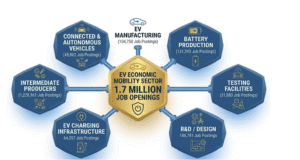
When we break the market down this way, occupational demand becomes much clearer. Some occupations are universally needed and cut across multiple subsectors—for example, Software Developers are highly demanded in CAV, Electric Vehicles, and EV Charging. Conversely, other roles are highly unique to a single subsector, such as Chemical Equipment Operators anchoring Battery Production, or Autonomous Vehicle Operators driving the CAV space.
When most people think of the EV transition, they think of the EV Manufacturing subsector—the direct manufacturing and assembly of the vehicles themselves. This core subsector alone generated 104,750 job postings nationwide, with an impressive average advertised salary of $120,614.
But the manufacturing footprint extends far beyond traditional automotive strongholds. A massive “battery belt” is driving immense demand. Tennessee, for example, generated over 1,000 postings in Battery Production and more than 35,000 in Intermediate Producers over the last five years. Similarly, states like North Carolina, Kansas, and Nevada are showing highly concentrated demand for battery materials and production, offering tremendous opportunities for local workforce boards to build specialized technical pipelines.
Because the EV ecosystem relies heavily on intermediate producers, charging networks, and testing, massive employer demand is showing up in states with smaller populations or areas you might not typically associate with EV dominance.
By using a blended importance score based on state subsector concentration (Location Quotient, or LQ) and job postings, the data reveals several unexpected hotspots:
Across the entire EV Mobility Sector, Total Demand reached 1,713,637 postings with an average advertised salary of $74,428. But the most critical finding is who these jobs are for. The EV sector is a “two-lane” market. While there is a lane for bachelor’s-degree engineering roles, the vastly larger opportunity sits in the middle: 70.5% of EV postings require a high school diploma or an associate degree. Furthermore, 56.9% of postings ask for just 0–1 years of experience.
Despite this, our training supply is dangerously misaligned. For bachelor’s degree pathways, supply is relatively strong, with a supply/demand ratio of 1.23. But for the sub-baccalaureate (Sub-BA) pathways that fuel 70% of the industry, the ratio plummets to a catastrophic 0.17. Shorter awards under one year have a ratio of just 0.16, indicating a massive shortfall in the exact skilled talent employers desperately need.
If employers need workers with sub-baccalaureate education and 1-2 years of experience, Registered Apprenticeships (RAs) and work-based learning models are the clearest way to bridge that gap.
In some areas, RA uptake is already showing strong success. Chemical Equipment Operators (crucial for Battery Production) saw a 64.1% growth in apprenticeships over the last five years, yielding an established base of 1,349 active RAs.
But in other critical EV occupations, the apprenticeship pipeline is virtually non-existent, creating an immediate opportunity for workforce boards to lean in:
The market is real, the jobs pay well, and the supply of talent is dangerously low. The Lightcast report outlines five strategic recommendations for local boards:
The Window of Opportunity is Open The demand is robust enough to justify immediate action. Workforce boards that move now will be uniquely positioned to shape who benefits from the EV transition in their communities.
DISCLAIMER: This workforce product was funded by a grant awarded by the U.S. Department of Labor (DOL’s Employment and Training Administration (ETA). The product was created by the recipient and does not necessarily reflect the official position of DOL/ETA. DOL/ETA makes no guarantees, warranties, or assurances of any kind, express or implied, with respect to such information, including any information on linked sites and including, but not limited to, accuracy of the information or its completeness, timeliness, usefulness, adequacy, continued availability, or ownership. This product is copyrighted by the institution that created it.
 Member Portal