NAWB Board Chair Submits Testimony to House Small Business Committee Subcommittee on Innovation, Entrepreneurship, and Workforce Development

Official Testimony

My name is Lisanne McNew, and I am the owner and CEO of SAFE Engineering in Monument, Colorado. Additionally, I serve as the Board Chair of the National Association of Workforce Boards (NAWB), Immediate Past Chair of the Colorado Workforce Development Council, and Past Board Chair of the Pikes Peak Workforce Development Board in Colorado Springs.

I appreciate the opportunity to testify today about the vital role of small businesses in workforce development and the support provided by workforce boards.

In Colorado, the Pikes Peak Workforce Development Board and our Workforce Center connect businesses with work-ready job seekers and employer-driven services. We assist residents of El Paso and Teller Counties in navigating career transitions—whether they are unemployed, underemployed, or facing other barriers. Our clients range from entry-level to professional, including youth, adults, returning workers, and those overcoming employment challenges. We offer job search and training opportunities, including 20 free job seeker workshops annually, as well as the largest virtual and in-person job fairs in Southern Colorado.

I’d like to share a few key initiatives that highlight our collaboration in small business development:

  • Incumbent Worker Training (IWT): We actively engage with Small Business Development Centers (SBDCs) to promote our programs, including the popular IWT (Employee Development Fund). Recently, five childcare businesses collaborated with an SBDC to apply for IWT grants, resulting in three businesses receiving $15,157 to upskill 38 employees—crucial for sustaining our local childcare workforce. With more resources, workforce boards could expand these efforts significantly.
  • Veterans: We participate in the SBDC’s Veterans Conference to assist veteran-owned businesses in attracting and retaining talent. We provide guidance on skills-based hiring, job descriptions, and other support to help them grow. Our Workforce Development Board is proud of this commitment.
  • Cybersecurity: As cybersecurity becomes increasingly critical for business success, we connect small businesses with high-quality training and resources. We are developing specific training on cybersecurity best practices for small businesses and regularly participate in cybersecurity initiatives to link workers with employers in this vital sector.

The potential for greater integration between workforce boards and small businesses is significant. Earlier this year, NAWB and the U.S. Small Business Administration (SBA) signed a Strategic Alliance Memorandum (SAM) to enhance collaboration and resource access.

The SBA is an ideal partner for NAWB, representing nearly 600 Workforce Development Boards that collaborate with education and economic development stakeholders to deliver regional workforce programs tailored to job seekers, businesses, and communities. Workforce boards manage over 2,300 American Job Centers and partner with various organizations to serve both businesses and job seekers effectively.

By providing SBA-sponsored assistance through its resource partners, we can better address the challenges of training and support services for small businesses, increasing awareness of available resources.

I hope my testimony illustrates the opportunities for workforce boards to bolster small businesses. Thank you for allowing me to share these insights with the Subcommittee.
Bi-Partisan House Resolution Supporting September 2024 as “National Workforce Development Month” Introduced

A bipartisan group of House members introduced House Resolution 1453

Reps. Suzanne Bonamici (D-OR), Brett Guthrie (R-KY), Glenn (GT) Thompson (R-PA), and Lucy McBath (D-GA), introduced the resolution which recognizes the vital role of workforce development in supporting jobseekers, businesses, and local economies. The resolution designates September 2024 as National Workforce Development Month.

Brad Turner-Little, President and CEO of NAWB stated,

“We are thrilled to see a bipartisan group of members of Congress taking action to recognize the vital economic role of workforce development… It is heartening to see the collaboration, often led by workforce development boards, receive this kind of recognition from Congress.”

The resolution specifically highlights that collaboration among multiple stakeholders—including state and local governments, workforce development boards, governors, state and local education and human services agencies, community colleges, local businesses, employment service providers, and community-based organizations—is essential for long-term, sustainable, and successful workforce development across traditional sectors and emerging industries.

The resolution also stresses the critical need for increased investment in workforce development, noting the following statistics:

  • The Bureau of Labor Statistics reported in July 2024 that there are approximately 8.2 million unfilled jobs in the U.S., which negatively impacts corporate productivity, reduces the local tax base, and hinders global competitiveness.
  • 76% of business leaders say that greater support for skills development would help their businesses.
  • As of August 2024, in the U.S., there are:
    • 7.1 million unemployed individuals.
    • Unemployment rates for Black and Hispanic adults are significantly higher than for White adults.
    • Workers without postsecondary education and skills development are more likely to be unemployed.
  • The Workforce Innovation and Opportunity Act (WIOA) supports employment, skills development, and support services for approximately 2.9 million individuals with barriers to employment, including:
    • Low-income individuals.
    • Long-term unemployed individuals.
    • Individuals displaced by outsourcing.
    • Individuals living in rural or persistently high unemployment areas.
    • Individuals looking to acquire new skills.
    • Individuals with disabilities.

The more than 550 workforce development boards and 2,400 American Job Centers are a driving force behind regional economic growth by providing resources and assistance to workers striving to compete in the 21st-century economy.

Read the full resolution here.

ACT NOW:

Contact your member of the House of Representatives (find them online or dial the House switchboard at 202-225-3121 and ask to be connected to your representative). Ask them to cosponsor House Resolution 1453 to recognize September 2024 as National Workforce Development Month.

Workforce Development Month 2024: EmployIndy’s Site Visit Success

Celebrating Workforce Development Month and EmployIndy’s Advocacy Efforts

Every September, we celebrate Workforce Development Month to recognize, honor, and publicize the contributions of our nation’s workforce development professionals. Throughout the year, we’ve received countless messages, writeups, and articles about your work and the success of your organizations. We are proud to share these as a testament to the innovative and life-changing work being done by our nation’s workforce development boards.

EmployIndy has done exceptional advocacy work over the past year, from local to state to federal levels. They have been a forerunner in advocacy, using all available tools and leaning on NAWB whenever we can offer assistance. We are thrilled to have such passionate and consistent members advocating on behalf of the workforce system and are proud to have been a supportive partner in these efforts.

“NAWB’s advocacy resources have been especially useful as we’ve engaged with our representation. They’ve been invaluable in quickly finding up-to-date information on federal policies and legislation, identifying areas of impact for our local area, and prioritizing which talking points and narratives to share with our congressional delegation. It has definitely helped hone our messaging!”
— Kevin Duffy, Senior Director, External Affairs, EmployIndy

Here are some of the actions that EmployIndy has taken to advocate for their needs and the broader workforce system:

Local Level

EmployIndy conducted their first Lunch and Learn for Indianapolis City-County Council members in July, offering crucial localized labor market information, sharing updates on city-funded programs, and providing a tour of their comprehensive American Job Center (AJC). They plan to conduct more Lunch and Learns with city council members in the future.

State-Wide

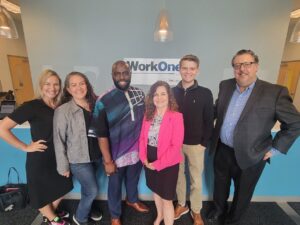
EmployIndy began bipartisan outreach to their local state legislature delegation, hosting two site visits with State Representatives Julie McGuire (R) and Carey Hamilton (D). Both visits were scheduled during Wednesdays at WorkOne, a weekly hiring event that brings over 20 employers and hundreds of jobseekers to the AJC.

In partnership with the Indiana Workforce Board Alliance (INWBA), EmployIndy also participated in INWBA Day at the Statehouse during the legislative session this past spring. This event sparked conversations leading to state legislature site visits. Future endeavors include outreach to the State Senate and House Education Committees for a Lunch and Learn at their AJC.

Federal Level

EmployIndy continues to engage with their congressional delegation to advocate for workforce development priorities, including Workforce Innovation Opportunity Act (WIOA) reauthorization, Department of Labor (DOL) Apprenticeship rulemaking, and agency appropriations.

They also hosted two separate site visits for congressional staff:

  • Jason Johnson from Senator Mike Braun’s office visited the AJC for a discussion and presentation on the workforce system. Other representatives from INWBA joined the meeting to share perspectives from across the state. This visit not only advocated for the workforce system at the federal level but also set the stage for potential future collaborations at the state level.
  • Andrew Murray from Senator Todd Young’s office toured the AJC to learn about EmployIndy’s services, including highlights from federal investments like the Creating Helpful Incentives to Produce Semiconductors Act and the American Rescue Plan. They also connected Andrew with one of their adult education partners, Warren Township Adult Education, for a concurrent visit and discussion on the role of adult education in workforce development.

Interested in hosting your own site visit? Download Hosting a Congressional Site Visit for tips.