NAWB logo
  • Partner with NAWB
  • Become a Member
  • Member Portal
Skip to content
  • Home
  • About
    • About NAWB
    • Our Board
    • Our Team
    • National Partners
    • Vision Partners
    • Regional Liaisons
  • Tools & Resources
    • Insights & Publications
    • Events
    • Career Center
    • RFP Center
    • Professional Development
    • Marketplace
  • Strategy in Action
    • Advancing the Skills Economy
    • Economic Mobility
    • Generative AI for Workforce
    • Registered Apprenticeship Resource Hub
    • Registered Apprenticeship Initiatives
    • Previous Initiatives
  • Advocacy
    • Workforce Advocacy
    • Legislative Agenda
    • Policy Statements and Advocacy Alerts
    • Resources and Tools
    • Coalitions
  • Events
  • The Latest
  • Member Login

The Latest

Beyond the Headlines: The Data-Driven Reality of the EV Workforce

  • By NAWB
  • |
  • April 21, 2026
  • |
  • Blog

If you follow the daily news cycle, the electric vehicle (EV) industry can seem like a rollercoaster. Between shifting federal investments, political debates, and fluctuating automaker commitments, it is easy to wonder about the true state of the EV economy.

But when we tune out the noise and look at the actual labor market data, a much clearer, undeniable reality emerges: The EV mobility market is not just a speculative future endeavor—it is here, it is massive, and it is critically starved for skilled talent.

With support from a U.S. Department of Labor Apprenticeship Building America (ABA) grant the National Association of Workforce Boards (NAWB) in partnership with Lightcast has released a comprehensive labor market assessment of the EV Mobility Sector. This report cuts through the hype to provide workforce boards, educators, and industry leaders with a data-driven roadmap for action. Here is a look at what the data reveals, and why local workforce systems are the key to unlocking this economic opportunity.

Understanding the Ecosystem: It Is More Than Just Manufacturing

To accurately gauge the workforce need, we first have to understand what the “EV Sector” actually is. The Lightcast study defines the EV Mobility Sector not as a single industry, but as a comprehensive value chain comprised of distinct subsectors:
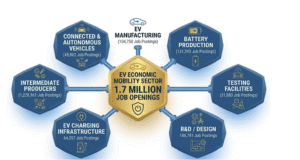
  • EV Manufacturing: The actual manufacturing and assembly of battery electric vehicles (BEVs) and plug-in hybrids (PHEVs).
  • Battery Production: Manufacturing cells and energy storage systems.
  • Testing Facilities: Vehicle testing, validation, and certification.
  • R&D / Design: Research and development for mobility innovations.
  • Connected & Autonomous Vehicles (CAV): Developing self-driving technology and intelligent systems.
  • Intermediate Producers: Suppliers of the components, parts, and materials feeding the entire ecosystem.
  • EV Charging Infrastructure: The development, installation, and maintenance of charging networks.

When we break the market down this way, occupational demand becomes much clearer. Some occupations are universally needed and cut across multiple subsectors—for example, Software Developers are highly demanded in CAV, Electric Vehicles, and EV Charging. Conversely, other roles are highly unique to a single subsector, such as Chemical Equipment Operators anchoring Battery Production, or Autonomous Vehicle Operators driving the CAV space.

The EV Manufacturing Core & The Battery Belt

When most people think of the EV transition, they think of the EV Manufacturing subsector—the direct manufacturing and assembly of the vehicles themselves. This core subsector alone generated 104,750 job postings nationwide, with an impressive average advertised salary of $120,614.

But the manufacturing footprint extends far beyond traditional automotive strongholds. A massive “battery belt” is driving immense demand. Tennessee, for example, generated over 1,000 postings in Battery Production and more than 35,000 in Intermediate Producers over the last five years. Similarly, states like North Carolina, Kansas, and Nevada are showing highly concentrated demand for battery materials and production, offering tremendous opportunities for local workforce boards to build specialized technical pipelines.

Unexpected Hotspots: The EV Boom is Happening Everywhere

Because the EV ecosystem relies heavily on intermediate producers, charging networks, and testing, massive employer demand is showing up in states with smaller populations or areas you might not typically associate with EV dominance.

By using a blended importance score based on state subsector concentration (Location Quotient, or LQ) and job postings, the data reveals several unexpected hotspots:

  • Utah is emerging as a powerhouse for EV Charging Infrastructure. With an exceptionally high LQ of 5.67, the state has generated nearly 1,000 specific postings in charging deployment, along with over 20,000 postings for Intermediate Producers.
  • Idaho shows a surprising and robust concentration in Connected & Autonomous Vehicles, generating 1,860 postings in this highly technical subsector.
  • Indiana and Ohio are dominating the critical supply chain, leading heavily in Intermediate Producers and R&D/Design. Indiana posted over 50,000 jobs, and Ohio over 68,000 jobs, in the intermediate supply roles that physically build the components for the national EV ecosystem.
  • Illinois and New York both rank at the top of the nation for concentration in EV Charging Infrastructure, with over 1,000 postings each specifically dedicated to charging networks.

The Supply Crisis in “The Middle”

Across the entire EV Mobility Sector, Total Demand reached 1,713,637 postings with an average advertised salary of $74,428. But the most critical finding is who these jobs are for. The EV sector is a “two-lane” market. While there is a lane for bachelor’s-degree engineering roles, the vastly larger opportunity sits in the middle: 70.5% of EV postings require a high school diploma or an associate degree. Furthermore, 56.9% of postings ask for just 0–1 years of experience.

Despite this, our training supply is dangerously misaligned. For bachelor’s degree pathways, supply is relatively strong, with a supply/demand ratio of 1.23. But for the sub-baccalaureate (Sub-BA) pathways that fuel 70% of the industry, the ratio plummets to a catastrophic 0.17. Shorter awards under one year have a ratio of just 0.16, indicating a massive shortfall in the exact skilled talent employers desperately need.

Registered Apprenticeships: Bridging the Gap Regionally

If employers need workers with sub-baccalaureate education and 1-2 years of experience, Registered Apprenticeships (RAs) and work-based learning models are the clearest way to bridge that gap.

In some areas, RA uptake is already showing strong success. Chemical Equipment Operators (crucial for Battery Production) saw a 64.1% growth in apprenticeships over the last five years, yielding an established base of 1,349 active RAs.

But in other critical EV occupations, the apprenticeship pipeline is virtually non-existent, creating an immediate opportunity for workforce boards to lean in:

  • Maintenance and Repair Workers (EV Charging): With over 64,000 postings and an average salary of $58,314, general repair pathways need to be adapted for charging deployment. States experiencing a massive concentration of EV Charging postings—like Utah, Illinois, and New York—should lean heavily into commercial technician work-based learning models.
  • Software Quality Assurance Analysts and Testers: Highly demanded in the CAV subsector (2,683 postings), yet there are zero active RAs in the data file. Boards in CAV-heavy states like Idaho, Washington, and Massachusetts should immediately prioritize tech and software validation apprenticeships.
  • Calibration Technologists and Technicians: With an incredibly high average salary of $132,103, there are only 33 active apprentices nationwide. This presents a highly lucrative, untapped pathway for technical talent.

A Playbook for Workforce Boards

The market is real, the jobs pay well, and the supply of talent is dangerously low. The Lightcast report outlines five strategic recommendations for local boards:

  1. Target the High-LQ Middle: Focus on accessible, sub-BA roles with strong EV concentration, such as high-voltage technicians, field service techs, and quality inspectors.
  2. Expand Stackable Sub-BA Pathways: Prioritize certificates and one-to-two-year programs, which remain the tightest and most under-supplied part of the market.
  3. Convene Employer Consortia: Do not wait for one flagship employer. Build work-based learning consortia around shared regional clusters (like battery firms, contractors, and charging companies).
  4. Use Salary Data in Outreach: Show job seekers that roles like High Voltage Technicians ($119k) and Commissioning Specialists ($73k) offer incredible earning potential without requiring a four-year engineering degree.
  5. Align with Local Subsector Demand: Use the data to map your specific regional strengths. Appendix A in the full report provides a 50-state quick reference to the top two subsectors in every single state, making it easy to connect national findings to your local context.

The Window of Opportunity is Open The demand is robust enough to justify immediate action. Workforce boards that move now will be uniquely positioned to shape who benefits from the EV transition in their communities.

Dive into the Data and the Resources:

  • Full Lightcast EV Mobility Sector Labor Market Assessment – The full labor market assessment summarizing findings across sub-sectors and geographies.  
  • EV Labor Market charts, graphs and tables – A powerpoint deck with all the underlying data presented in charts, graphs, and tables 
  • Brief 1: The Role of Workforce Boards in the EV Registered Apprenticeship Ecosystem – An overview of the EV charging landscape, the emerging workforce challenges, and the strategic role WDBs can play
  • Brief 2: Building the Conditions to Grow the EV Workforce: Lessons from Kansas, Illinois and New York – Explores what it takes to build the partnerships and pathway infrastructure that can support Registered Apprenticeship over time.
  • Read our Event Recap: From EV Hype to Workforce Strategy Pitch Competition
  • Registered Apprenticeship Toolkit and Resource Hub: A set of trusted references, practical tools, and real-world examples that reflect how apprenticeship is being used across the workforce system and how workforce boards can engage

DISCLAIMER: This workforce product was funded by a grant awarded by the U.S. Department of Labor (DOL’s Employment and Training Administration (ETA). The product was created by the recipient and does not necessarily reflect the official position of DOL/ETA. DOL/ETA makes no guarantees, warranties, or assurances of any kind, express or implied, with respect to such information, including any information on linked sites and including, but not limited to, accuracy of the information or its completeness, timeliness, usefulness, adequacy, continued availability, or ownership. This product is copyrighted by the institution that created it.

NAWB Logo
Locate Us:
1155 15th Street NW
Suite 725
Washington, DC 20005
Contact Us:
P: 202.857.7900
F: 202.857.7955
E: nawb@nawb.org
Connect with Us:
  • LinkedIn
  • Instagram
  • X
  • YouTube
  • Subscribe
Be Involved:
  • Become a Member
  • Speaking Requests
  • Media Request

  • © 2026 National Association of Workforce Boards
  • |
  • Privacy Policy
  • |
  • Careers